Monday, July 28, 2025

Natural Selection And The Bible

Natural Selection And The Bible

Bodie Hodge, M.Sc., B.Sc., PEI

Biblical Authority Ministries, July 28, 2025 (Donate)

Well, it’s pretty obvious to any farmer whose raised animals—they change. From generation to generation, there are usually noticeable variations. This also occurs out in nature all over the world.

Photo by Bodie Hodge

These little changes never change a pig into a moth, a cow into a dinosaur, a raccoon into a toad, or a bear into deer. Nevertheless, these types of small observed changes (longer hair, shorter hair, longer beaks, shorter beaks, taller, shorter, various pelt colors, etc.) are what evolutionists often suggested added up to big changes over long periods of unobserved time.

But did they? This brings us to the subject of the nature of how animals change through the generation based their genetics, their environment, and host of other factors. Of course, there are mutational changes (discussed here) but I want to discuss a process that is named “natural selection”.

How should we view this process in light of Scripture and the biblical age of the earth, and does it do what evolutionists hope it does?

Natural Selection—The Opposite Of Evolution

Natural selection is a real, observable process in nature—but it does not support molecules-to-man evolution—I’ll dive into the details of that in a moment. Instead, natural selection is a conservative mechanism that helps following generations survive in changing environments.

In our sin-cursed and broken world since Genesis 3, animals die. But they also reproduce and make variant copies of themselves. Some of these variations, for instance can have longer hair or shorter hair. This is determined at a genetic level.

Image from Presentation Library

Since dogs exist all over the world, let’s use dogs as our example (even though I could use bears, cats and so on as well). 

Some member of the one cat kind as they have varied after the Flood in various parts of the world. (Image generated by AI per Bodie Hodge 7/28/2025)

Dogs with longer hair can thrive better in a region where it gets very cold, whereas dogs with short hair don’t like that and either move away to where it is warmer or die off.

Image from Presentation Library

At the same time, dogs with shorter hair might thrive in a region that is much hotter. The dogs with longer hair are either going to die off or move away to a place more comfortable for their survival. So, dogs with medium length fur and can have offspring that have long hair or short hair and they can expand and do well in different parts of the world. This is the basics of natural selection.

Notice a couple of key points:

·       The information already existed in the genome.

·       This process filters and loses information in the genome.

Dogs living in a hotter area with only short hair have lost the information for long hair and likewise, the dogs living in a colder area have lost the information for short hair. Unless they breed back, that information is gone in their local variation.

Image from Presentation Library

The point is that it is predicated existing genetic information, having minor variations rather than creating new kinds of organisms—in other words dogs stay dogs—whether there are wolves, Great Danes, dingoes, beagles, or bulldogs. This also means that natural selection works in the opposite direction of evolution as commonly defined in secular understanding.

Natural selection is the process by which certain traits become more common in a population because they help individuals survive and reproduce. For example, in a cold environment, other animals, like the dogs above, with thicker fur may survive better, and their offspring inherit that trait.

This is not an example of evolution in the macro sense (e.g., fish turning into amphibians). Instead, it’s a form of variation within a kind—a group of organisms that descended from an original created pair and the limited pairs aboard the Ark during the Flood about 4,350 years ago.

God created the original "kinds" of animals with a great deal of built-in genetic diversity (God’s brilliant that way!). After the Fall and the global Flood, our sin-cursed environments changed drastically.

Natural selection helps explain how animals survive in these new conditions down through the generations due to the existing information in their genes. No new genetic information is added in the process—rather, information is often lost or shuffled. In this way, natural selection results in downward and filtered adaptation, not upward evolution with new complex information.

Image from Presentation Library

Variations have a filtering effect of genetic information, but filtering dog information will never lead to a cat. Image from Presentation Library

For instance, when a population of beetles is exposed to a new predator, those with camouflaged coloring may survive better. Over generations, the population might shift to being mostly camouflaged. This doesn’t mean beetles have evolved into a new kind—it simply means one variation has become more dominant while the others were eaten! In fact, in many cases, natural selection leads to a reduction in genetic diversity (though sometimes it is nearly the same), because traits that don’t aid survival may be removed from the population (or is so few/recessive in the population it may appear latent.)

Thus, natural selection and evolution go in opposite directions. Evolution (as defined by Darwinists) requires the gain of new, functional genetic information over time to turn simple organisms into complex ones. Natural selection, however, only works with existing information and typically reduces diversity (e.g., the population of long-haired dogs living where it is cold can only have offspring with long hair). For example, a population of wolves may become adapted to arctic conditions, but this specialization can make them less suited for other climates, which is evidence of degeneration, not advancement.

Image from Presentation Library

Natural selection must not be confused with random mutations, which are often harmful. Evolutionists claim that over time, beneficial mutations can add new information, and natural selection favors these changes. But observed mutations are overwhelmingly either nearly neutral or harmful, and no known mutation has been shown to add brand-new, organized and complex genetic information of the type required for sufficient molecules-to-man evolution.

Furthermore, natural selection is not a creative force. It cannot plan, innovate, or direct evolution—it only filters traits that already exist. Some may get confused because of the name, but nature does not select—it doesn’t have a mind. It is merely name given to an observed process based on the offspring variation and the environments in which they organism lives (or tries to live) which was also designed by God, albeit cursed design since the Fall.

Nevertheless, this filtering process aligns with a biblical worldview: after sin entered the world, death, disease, and environmental pressures began to shape the survival of species. Natural selection helps explain how animals have adapted since the Flood, but always within the boundaries of their created kind.

  • Natural selection is a real, observable process that helps explain why organisms survive in changing or different environments.
  • The process operates on existing genetic information and usually results in the loss of diversity.
  • The process leads to downward and filtered adaptation within a kind, not the onward and upward evolution of new kinds.
  • Electron-to-engineer evolution requires the addition of brand-new complex and usable genetic information over time, which natural selection does not provide.
  • The process actually works in the opposite direction of evolution, as it conserves or reduces genetic information instead of creating it.

Darwin, Blyth, And Natural Selection

As the Bible-believer might have already noticed, natural selection fits well within a biblical framework of a world that has changed since creation but does not confirm the unobserved evolutionary suggestion of life developing from a common ancestor through random processes over millions of years.

For those in the know, it wasn’t Charles Darwin, who first articulated natural selection. Though I must give credit to Darwin for naming the process.

A couple of decades before Darwin, a Christian names Ed Blyth articulated the process in journal articles. These papers influenced Darwin. Historically and rather well-known was that Darwin had hand written notes on his copies of Blyth’s papers—these were kept on his desk at Down House (where Darwin lived for 40 years) and visitors could see them sitting there even into recent times on tours of the home.  

But unlike Blyth who recognized the conservative nature of the process, Darwin hopes this idea of natural selection would lead to evolution.

Darwin dedicated his life attempting to make natural selection work as the mechanism for evolution. But Darwin backed off his “gung-ho” view of natural selection later in his life. He became much more tentative about natural selection wondering if there was another mechanism that could actually help evolution.

Naturally after Darwin, Hugo DeVries suggested mutations were the mechanism as opposed to natural selection. In modern times, the neo-Darwinian religious view incorporated mutations and natural selection, but both processes have been shown to go in the wrong direction for evolution. So, learned evolutionists are still looking for a mechanism that would make evolution work.

Who Was Ed Blyth?

Edward Blyth, an English zoologist and chemist, significantly contributed to the initial understanding of what would later be called “natural selection”, even though he did not formulate or name the process. It was Charles Darwin that gave the name “natural selection”.

Edward Blyth, 1810-1873

Blyth's contributions appeared in a series of published papers in The Magazine of Natural History between 1835 and 1837, where he discussed the role of natural processes in preserving the fitness of animal populations. Some of his papers are online here (off site):

·       An Attempt to Classify the 'Varieties' of Animals with Observations on the Marked Seasonal and Other Changes Which Naturally Take Place in Various British Species, and Which Do Not Constitute Varieties - Part 1

·       An Attempt to Classify the 'Varieties' of Animals with Observations on the Marked Seasonal and Other Changes Which Naturally Take Place in Various British Species, and Which Do Not Constitute Varieties - Part 2

·       Observations on the Various Seasonal and Other External Changes Which Regularly Take Place in Birds - Part 1

·       Observations on the Various Seasonal and Other External Changes Which Regularly Take Place in Birds - Part 2

·       Observations on the Various Seasonal and Other External Changes Which Regularly Take Place in Birds - Part 3

·       Observations on the Various Seasonal and Other External Changes Which Regularly Take Place in Birds - Part 4

·       On the Psychological Distinctions Between Man and All Other Animals - Part 1

·       On the Psychological Distinctions Between Man and All Other Animals - Part 2

·       On the Psychological Distinctions Between Man and All Other Animals - Part 3

·       On the Psychological Distinctions Between Man and All Other Animals - Part 4

In his writings, Blyth discussed the idea that variations occur within kinds and that nature acts to conserve the type rather than change it. He observed that in the wild, weaker or less fit individuals often died, while the stronger and better-adapted ones survived.

This process, he believed, helped maintain the stability and health of species by removing individuals that deviated too far from the norm. For Blyth, this "conservative" principle served as a natural mechanism to preserve species in a sin-broken world, not transform them into new kinds.

In his 1835 paper titled “An Attempt to Classify the ‘Varieties’ of Animals,” Blyth described how domesticated animals often change under human control (this is called artificial selection by the way), but in the wild, the reverse happens—wild animals retain their typical traits because of environmental pressures.

In later articles, especially in 1837, he expanded on this concept by suggesting that predators and harsh conditions serve as natural checks that weed out the unfit, ensuring that only well-adapted individuals reproduce.

Though Blyth did not advocate for evolution, his descriptions of this natural "pruning" process what Darwin would later call natural selection. Darwin himself openly acknowledged Blyth’s work in On the Origin of Species, noting Blyth's valuable data and insights, though he diverged sharply from Blyth's belief that kinds were fixed and created by God.

Blyth contributed detailed documentation of how environmental pressures influence survival and reproduction in wild populations. While he framed these observations within a creationist, species-fixity (i.e., fixity of kinds) worldview, the mechanisms he described helped lay the groundwork for the concept of natural selection by showing how weaker individuals die out leaving that more fit left to survive.

Conclusion

When natural selection is understood, it meshes very well in a biblical worldview. Yet, it is a process that goes in the wrong direction for an evolutionary worldview. It’s that simple.


Images from Presentation Library 

Bodie Hodge, Ken Ham's son in law, has been an apologist since 1998 helping out in various churches and running an apologetics website. He spent 21 years working at Answers in Genesis as a speaker, writer, and researcher as well as a founding news anchor for Answers News. He was also head of the Oversight Council.  

Bodie launched Biblical Authority Ministries in 2015 as a personal website and it was organized officially in 2025 as a 501(c)(3). He has spoken on multiple continents and hosts of US states in churches, colleges, and universities. He is married with four children. 


Friday, July 25, 2025

Was The Forbidden Fruit An Apple?

Was The Forbidden Fruit An Apple – And How Did Eve Know It Was Edible?

Bodie Hodge, M.Sc., B.Sc., PEI

Biblical Authority Ministries, July 25, 2025 (Donate) 

If you were to open a children’s book about Adam and Eve and read about their sin, chances are that they will say that Adam and Eve ate an “apple”. Having children of my own and receiving kind gifts relating to Genesis, such as Bibles for kids, I usually have to look them over for any big red flags.

When these children’s books say that the fruit was an “apple,” I usually get frustrated—so I get frustrated a lot, as this is a common problem (like the righteous anger Nehemiah felt in Nehemiah 5:1-7)! 

Apple (istockphoto-186843005-170667a; free use image)

In addition, it is not just in children’s books, but seems like common knowledge. For example, it made its way into an encyclopedia: 

Many people believe an apple was the fruit that, according the Bible, Adam and Eve ate in the Garden of Eden.[1] 

The confusion of this fruit with the apple may be due to the similarity of the two words in the Latin translation, known as the Vulgate. The word "evil" in the tree's name in Latin is mali (Genesis 2:17). The word apple in other places is mala (Proverbs 25:11) or malum (Song of Solomon 2:3).  It seems like this similarity may have led to the confusion. In the original Hebrew, the words are not even close to the same. The word in Genesis 2:17 for evil is rah, while the word for apples in Proverbs 25:11 and Song of Solomon 2:3 is tappuwach. 

Why Not An Apple? 

Simply put, the Bible doesn’t say the fruit was an apple. Furthermore, apples are mentioned in Scripture (e.g., Song of Solomon 2:3; Song of Solomon 8:5; Joel 1:12), but not in the Garden of Eden scene, which is where the Tree of the Knowledge of Good and Evil was located (as well as the Tree of Life).  

The forbidden fruit was indeed a real fruit, but not necessarily an apple. It was the fruit that bore from the Tree of the Knowledge of Good and Evil.  

The Fruit 

What did fruit from the Tree of the Knowledge of Good and Evil look like? We simply don’t know. Though, some have speculated. In fact, various artists have developed different depictions such as: 

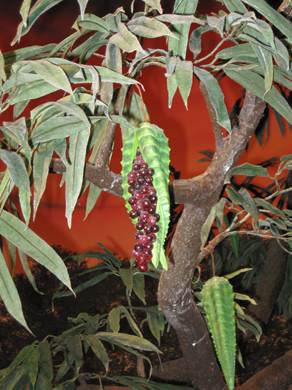
As shown in the Creation Museum; Photo by Bodie Hodge 

As shown in the original A is for Adam, book; Image from Presentation Library.

This last one, which was done for children, could be used for humor as well. After Dan Lietha deliberately designed the fruit to not look like an apple, Ken Ham often joked that this fruit looks rather similar to hand grenade! This would truly have devastating implication if eaten!

Regardless, we simply have no idea what the fruit looked like and only speculation within biblical limits should be warranted. 

How Did Eve Know That The Fruit Was Edible And Desirable To Make One Wise? 

Some have tried to ponder how Eve knew that the fruit was edible and for that matter, desirable to make one wise. Let’s address this first part first.  

We seem to be in a predicament because of Genesis 2:16-17, which says: 

And the LORD God commanded the man, saying, "Of every tree of the garden you may freely eat; "but of the tree of the knowledge of good and evil you shall not eat, for in the day that you eat of it you shall surely die." 

Here, Adam was commanded not to eat and this command made it to Eve as well; albeit, she did not articulate it properly to the serpent (Genesis 3:2-3). Therefore, one may assume that the fruit would be impossible to eat (non-edible). 

However, take note of what the Lord God says: “for in the day you eat of it.” The Lord knew that Adam would eat. So, the fruit was edible.[2] However, I do not suggest that this was the reason Eve knew the fruit to be edible. The Bible reveals something else. 

Eve noticed something in Genesis 3:6. It says that she saw that the fruit was good for food. Thus, she was not reminiscing about what God had said, but something else had caught her eye regarding the fruit. 

Keep in mind that mankind was not permitted to eat the fruit of the Tree of the Knowledge of Good and Evil, but the Bible did not give any forbidding warning to animals. It is possible that an animal, perhaps even the serpent, took some of the fruit and ate before Eve so that she could see that this fruit was “good for food”. 

Secondly, seeing the fruit being eaten may have been a triggering action for Eve to realize that the fruit could be eaten by them as well. This very thought process in turn could be what made her think she had gained wisdom (e.g., if an animal could eat it, then so could she and Adam). Wisdom incorporates the finding out of knowledge (see Proverbs 8:12). Note that Eve didn’t have to eat to gain wisdom. The aspect of gaining wisdom was not based on eating the fruit, but on visual acuity. 

Of course, there may have been a bit more deception than this. Had the serpent eaten in front of her, he could have cleverly made it appear as though it had gained some wisdom. Regardless, she most likely saw something eat that fruit in order for her to view that it was edible and desirable for gaining wisdom.

Conclusion 

Either way, Eve’s actions and thought processes mimicked that of James 1:14-15. She cannot blame the serpent entirely for its cunning deception, but it was her own actions of eating that cannot be ignored—and the same with Adam (2 Corinthians 11:3).

We should learn that we too should not be deceived, which is why checking things against Scripture and viewing the Scriptures as the authority should be the goal of any Christian (Acts 17:11).    


Bodie Hodge, Ken Ham's son in law, has been an apologist since 1998 helping out in various churches and running an apologetics website. He spent 21 years working at Answers in Genesis as a speaker, writer, and researcher as well as a founding news anchor for Answers News. He was also head of the Oversight Council.  

Bodie launched Biblical Authority Ministries in 2015 as a personal website and it was organized officially in 2025 as a 501(c)(3). He has spoken on multiple continents and hosts of US states in churches, colleges, and universities. He is married with four children. 

Originally at Answers in Genesis; Edited; Republished by permission.


[1] The World Book Encyclopedia, Volume 1, World Book, Inc., Chicago, Illinois, 1990, Page 570.

[2] Considering that Adam and Eve were preprogrammed with language and knowledge so that they could immediately converse with God, then they may have known right from the start that the fruit was edible. Though I would leave open the possibility that this was some of the knowledge that they didn’t need; and hence, not programmed into them. After all, they did not possess all knowledge, like God does (Colossians 2:3). 

Wednesday, July 23, 2025

Top 15 Illustration Problems in Genesis 1–11

Top 15 Illustration Problems in Genesis 1–11

Bodie Hodge, M.Sc., B.Sc., PEI

Biblical Authority Ministries, July 23, 2025 (Donate)

I want people to realize the Bible is true right from the start, so it is good to avoid mistakes in some of the artwork depicting the events of Genesis 1–11. From time-to-time, people write books or articles with illustrations on the early pages of Genesis. Oftentimes, I see illustrated Bibles, particularly children’s Bibles or books on Genesis, that make the same classic mistakes.

In fact, I’ve seen so many of these books that I decided to list the classic mistakes in the illustrations (and a few extra ones dealing with the text) in hopes that artists and authors can use this in the future to make their books more accurate and effective.

When I see some brilliant artwork with inaccuracies in the illustrations or text, I usually stop and sigh because I really wish the message was accurate so that as a ministry we can say, “Here is a good product you can use to train the next generation.”

But these errors creep in, often due to simply looking at someone else’s artwork with the same mistakes, and it subtly undermines the Bible right from the start. We want people to realize the Bible is true right from the start, so it is good to avoid common mistakes and correct some of the artwork depicting the events of Genesis 1–11—the foundational chapters of Scripture.

Here are some of the common problems I have found in the first eleven chapters of Genesis: 

1. The Globe Looks Like It Does Today: This Would Specifically Be Before The Flood In Genesis 6–8. The earth was destroyed and rearrangements on a continental scale resulted from the Flood. In light of Genesis 1:9, many believe there was only one continent originally. Though we should not be dogmatic on this position, we know the Flood caused vast changes, leaving us with the seven broken continents we have today (Genesis 7:11; Psalm 104:8–9).
This is the earth after the global Flood of Noah's Day. Before that it was different, thus one has some liberty on pre-Flood arrangements. Image from Presentation Library.

2. Leaving Open Evolutionary Ideas: There is no need to impose evolutionary ideas on the Bible. These ideas come from the religion of humanism, and it contradicts the Bible. Sadly, some artists do mix humanistic thinking [like astronomical evolution (big bang as in progressive creation), geological evolution (millions of years as in the gap theory or progressive creation), chemical evolution (chemical origin of life without God) or biological evolution (like theistic evolution)]. These things are usually placed prior to the first day of creation. But God created everything in six days (Exodus 20:11; 31:17), and the context shows these were normal-length days. There is no need to take secular ideas and force them into the Bible. This removes the Bible as the authority when it comes to the age of the earth. One common example is showing stars in the background in pictures showing the creation of earth—the sun, moon, and stars were created on Day Four, after the earth.
 
3. Not Including Extinct Creatures Like Dinosaurs On Day Six: Dinosaurs were land animals after all, so they were made on Day Six just before mankind (who were made later that same day). The same is true with land-based insects.
Dinosaurs were made on day 6 (being land animals); Image from Presentation Library.

Also, there should be pterosaurs, bats, and flying insects with all of the birds and sea creatures like the plesiosaurs on Day Five with the fish and whales.
 
4. Putting Modern Variations Of Animals In The Creation Scene: Zebras, Clydesdales, and donkeys are all part of the horse kind and came to look like they do today since the Flood and are all part of the one horse kind. Species and the biblical kind are not necessarily the same things. The original horse kind likely had features resembling each of these. They diversified into what we have today through natural selection in the wild and artificial selection by man and for man’s benefit. The same is true with the cat kind. 

Domestic cats, lions, bobcats, tigers, and so on, are all part of the one cat kind that has developed through variations since the Flood. It is better to draw generic representatives of each kind, such as the cats, horses, parrots, deer, and elephants (which includes mammoths and mastodons, Asian, African, and so on). The various animals and plants within a created kind could have been created with some variety, but the odds of that variety being identical with post-Flood variations are astronomical, nor does the Bible allude to this being the case. 

The fossils from the Flood do not attest to identical selection features within the kinds compared to what we have today. Though there may be some examples where little change has occurred in that particular kind, animals that have great variation, like mammals and reptiles, should not be drawn exactly like animals today. Likewise, a Triceratops doesn’t necessarily represent the Ceratopsian kind that God originally created. It is only one of many forms we find in the fossil record.
 
5. Drawing Adam And Eve With Very Light Skin And Blond Hair And Blue Eyes: Adam and Eve were likely middle brown, having the information for both darker skin (which is largely based on more melanin production in skin) and lighter skin (likewise, less melanin production in the skin). Thus, even in one generation they could have had children that were darker or lighter in skin shade.
Adam and Eve likely had middle brown skin tone (not blond hair and blue eyes) so that it was possible for all the various skin shades today. Image from Presentation Library.

The same sort of thing is likely true with Noah.
 
6. Making An Apple The Fruit: The fruit was real and came from a fruit tree named the Tree of the Knowledge of Good and Evil. We don’t know what it looked like, but since it was “pleasant to the eyes,” it probably wasn’t too repulsive (Genesis 3:6.) But there is no reason to assume the fruit was an apple. As I’ve mentioned before, “The confusion of this fruit with the apple may be due to the similarity of the two words in the Latin translation of the Bible, known as the Vulgate. 

The word evil in the tree’s name in Latin is mali (Genesis 2:17). The word apple in other places is mala (Proverbs 25:11) or malum (Song of Solomon 2:3). It seems like this similarity may have led to the confusion. In the original Hebrew, the words are not even close. The word in Genesis 2:17 for evil is rah, while the word for apples in Proverbs 25:11 and Song of Solomon 2:3 is tappuwach. We do know that it was a real fruit, growing on a real tree, in real history—and the impact of the rebellious eating of that fruit is still felt acutely today by every single person (in fact, the whole creation).”[1]

7. Having A Serpent Without Some Form Of Upright Posture Or Appendages During The Deception: Genesis 3:1 Calls It A Serpent. Part of the Curse was that the serpent was to crawl on its belly. This may indicate that the Curse produced a snake or a serpent with shortened legs. So, it is better to have a serpent more upright prior to the Curse and lower (i.e., crawling on its belly) after the Curse.

8. Neglecting That God Sacrificed Animals To Cover Adam And Eve: This is the very basis for the gospel in Genesis 3. The punishment for sin was death (Genesis 2:17), so death was part of the solution. This sin-death relationship is why Jesus Christ stepped into history to die for our sins. God covered Adam and Eve with skins (Genesis 3:21) to replace the fig leaf coverings Adam and Eve tried to make for themselves. 

This is the basis for wearing clothing (to cover the shame of sin) and for the sacrificial systems that Abel, Noah, Abraham, Jacob, Job, and the Israelites followed. The sacrifice of animals was not good enough to satisfy God’s wrath upon sin. The punishment from an infinite and holy God is an infinite punishment. We needed Jesus Christ, the Son of God, who is infinite, to pay the infinite punishment we deserve, and only He could truly bear the punishment and satisfy the wrath of God so that the free gift of salvation could be offered. 

The very basis for the gospel is found in this first sacrifice. Many illustrators or even children’s Bibles (and so on) neglect the Fall and even have Adam and Eve remaining in fig-leaf clothing. This needs to be remedied to accurately reflect life after the Fall and our need for a Savior.
 
9. When Illustrating Cain And Abel, We Often Get The Impression They Were The Only Two Kids Adam And Eve Had At The Time: First, Cain had a wife per Genesis 4:17 (i.e., a sister or niece—either way, brothers and sisters had to marry originally, and this was okay until after the Exodus with Moses giving the Law in Leviticus 18). Remember, Abraham married his half-sister, and Moses’ father (Amram) married his aunt (Jochebed). Genesis 5:4 indicates that Adam and Eve had other sons and daughters after Seth. Since the Bible mentions a girl and two boys before Seth, as well as all those whom Cain feared in Genesis 4:14, there were surely several other children by the time Cain killed Abel.
 
10. Ark Looks Like A Bathtub With Happy Animals Sticking Out Of It: The Ark was a huge vessel measuring an overall 300 by 50 by 30 cubits. Depending on the long or short cubit, it was either about 450 feet long or about 510 feet long (a long/older cubit was a hand-breadth longer than the normal cubit, which was the measurement from a person’s fingertips to their elbow). The longer cubit of about 20.4 inches is more likely since most ancient structures in the Bible were built using the longer/royal cubit, like the Temple mentioned by Ezekiel (Ezekiel 40:5, 43:13). Animals were confined in rooms inside the Ark, and it wasn’t a happy time. God was judging sin and, except for the eight on the Ark, the whole world perished (2 Peter 3:6).
"Bathtub" arks would never float; Image from Presentation Library.

Noah probably had brothers and sisters die in the Flood (Genesis 5:30). The dimensions for the Ark give the total length, width, and height. Some picture it as a box shape, which is better than the bathtub look, but we need to keep in mind a Corvette’s dimensions can also be given as length, width, and height too, yet it is not a box. The Ark was a ship, so it should have features like a ship to help it survive the Flood, even though it did not have to navigate to any specific location. Removing square angles that can more easily be destroyed and having something to help direct it into the wind and waves for safety should be drawn to make it more realistic. The Bible doesn’t rule out this sort of design.
 
11. Not Including Dinosaurs And Pterodactyls (e.g., Dragons) On The Ark: According to Genesis 6:20, these animal kinds would have been on the Ark. It was after the Flood that these animals died off. It was for the same reasons all sorts of animals went extinct and continue to . . . sin! Specific reasons for the extinction of dinosaurs include being hunted, a changed environment, genetic problems, local catastrophic events, diseases, and so on (i.e., think of the reasons on the endangered species list). So, two of the sauropod kind, two of ceratopsian kind, and so on, should be included.

12. Putting Too Many Individuals Of A Kind On The Ark: We often see lions and tigers and other cats entering or exiting Noah’s Ark.[2] There is only one cat kind (cats can interbreed with each other), so Noah only took two cats on the Ark. Of course, they had the genetic information which can account for the cat variations we see today (as a result of various selection processes over time). The same with dogs—there is only one dog kind, so Noah only needed two dogs on the Ark, no dingoes, wolves, coyotes, and so on. The same goes for the bear kind, ceratopsian kind, sauropod kind, elephant kind, horse kind (p.s. Zebras are part of the horse kind—they are a variation of the horse that is post-Flood), and so on. Learn more about kinds here.
 
13. Tower Of Babel Being Rounded: It was likely a pyramid or a ziggurat (step pyramid) instead of rounded. The Hebrew word for tower here is migdal, which is most often translated as “tower,” figuratively means a “pyramidal” bed of flowers. 

Tower was likely ziggurat in shape; Image from Presentation Library.

A ziggurat-style shape makes sense since this is the same style building project people took with them to other places around the world after fleeing from Babel. Pyramids are a specified type of ziggurat. Even historical accounts like that of Herodotus (an old Greek historian in the 5th century BC who saw a later iteration of the Tower of Babel before it was torn down) described it as a ziggurat.[3] There is also an archaeological artifact, the Tower of Babel stele, which has Nebuchadnezzar and the old run-down Tower of Babel engraved on it, and the tower is a ziggurat shape.
 
14. Tower Of Babel Reaches So High Into The Atmosphere That Its Top Is Covered With High Cirrus Clouds: It was a tower whose “top was in the heavens” (Genesis 11:4), but this does not mean it reached to space or the high stratosphere. Some of the 30 or so ziggurats that still remain in the Mesopotamian area have names that reflect something similar: Temple of the Stairway to Pure Heaven (Sippar) and the Temple which Links Heaven and Earth (Larsa), yet these towers do not reach up into the stratosphere. It simply meant that it reached far higher than the rest of the structures around it.

15. The Tower Being Only Partially Built (i.e., A Foundation): The Tower was built, according to Genesis 11:5 by most translations; it was the city that they stopped building (Genesis 11:8.) This has often been a point of confusion for many. Some have thought that the Hebrew wording doesn’t mean it was built, but the word for built/building is banah/baanuw and is used in a perfect tense meaning complete, e.g., perhaps some finishing touches were necessary. This could be complete up to a certain point (at the time of judgment) to serve the purpose if its final intent by keeping people from scattering. 

It is the context that should determine this. Many point to verse 8, but this only helps with the meaning regarding the state of the city, not the Tower. We can be confident that for the most part it was complete (e.g., the Tower was not a merely a foundation). If one argued that the Tower was not built to any significant degree, then one would have to argue that hosts of structures in the Old Testament were also not built, such as the Temple (e.g., 1 Kings 10:4), many houses (e.g., 1 Kings 9:24), many cities (e.g., Numbers 32:37-38), and so on since they all use this same Hebrew word in a perfect tense.[4] 

Furthermore, banah is used not just in reference to the Tower but also to the city in verse 5. If we were to argue the tower was not built, then we would have to argue that the city was not built to any degree either.[5]

Here are a couple more helpful guidelines that can be useful when dealing with the text in an illustrated Bible.
 
Not Using Biblical Dates: Why use secular timeframes instead of biblical timeframes when publishing a Bible? For example, don’t use BCE and CE; use BC and AD to honor Jesus as the focal point of history. Also, use biblical dates from a respected chronology like Ussher or Jones, not questionable dates that come from faulty assumptions like secular mythology or radiometric dates that are repeatedly in error. Stick to the biblical age of the earth and dates given in the Bible.

Calling The Accounts “Stories”: Although “story” does not necessarily imply myth or fairy tale, it is becoming more popular for people to use it in reference to fairy tales in today’s culture (e.g., Cinderella, Shrek, and so on). Bible authors did not view the Bible’s recorded history as fairy tales but as actual history—accurate accounts of what took place. Hence, it is better to say “account”, “history”, “what occurred in the past”, etc.
 
Don’t Paraphrase The Bible—Use A Respectable Translation: What often happens is that people want to “dumb down” or truncate the text for children, but this often introduces errors from the author—it can happen to all of us. People can understand more than many might think, including children.

Placing The Garden Of Eden Based On Post-Flood Geography: Many try to put the Garden of Eden in the Middle East, in Iraq. However, the Flood destroyed the Garden of Eden, and the Tigris and Euphrates Rivers were later merely named for these pre-Flood rivers. The geography doesn’t match—direction of flow, etc. There was one river in Eden that broke into four headwaters, so these modern rivers cannot be the rivers mentioned in Genesis 2.

The Garden of Eden was not located here; It was destroyed in the Flood and this is now post-Flood features; The names Tigris and Euphrates Rivers were transferred forward to the new world. Image from Presentation Library.

Hopefully, these will help get you started as you evaluate teaching materials or seek to develop your own. But keep in mind there may be other mistakes, and all these must be checked against the text of Scripture—the authority when it comes to these matters. 


Bodie Hodge, Ken Ham's son in law, has been an apologist since 1998 helping out in various churches and running an apologetics website. He spent 21 years working at Answers in Genesis as a speaker, writer, and researcher as well as a founding news anchor for Answers News. He was also head of the Oversight Council.  

Bodie launched Biblical Authority Ministries in 2015 as a personal website and it was organized officially in 2025 as a 501(c)(3). He has spoken on multiple continents and hosts of US states in churches, colleges, and universities. He is married with four children. 
Originally at Answers in Genesis; Edited; Republished by permission.


[1] Bodie Hodge, https://www.biblicalauthorityministries.org/2025/07/was-forbidden-fruit-apple.html.

[2] When animals came off the Ark, they came off by their “families” (Genesis 8:19), so it is possible some animals had offspring while aboard the year-long trip on the Ark. But this doesn’t mean we should have full-grown bobcats, lions, tigers, and so on coming off in great quantities from the cat kind.

[3] Herodotus, The Histories, Book 1.181, ed. John Marincola, translated by Aubrey de Selincourt in 1954, Penguin Books, 1996, pp. 71-72.

[4] The LXX added the word tower to Genesis 11:8 in their translation without biblical warrant, and this has likely been the main reason some still think the Tower was partially built. The LXX is good in many places, but is not known as a good translation in Genesis, messing up the ages of the patriarchs [e.g., Noah’s grandfather Methuselah would be living over a decade after the Flood without being on the Ark; mistranslates “sons” as angels in Genesis 6:2 (6:3 by the LXX’s reckoning); mixing the Greek philosophy of the day by having a solid dome to translate expanse (raqiya) as something solid and firm, and so on]. So by sticking with the Masoretic text (standard Hebrew text), there is no reason to assume the Tower is in reference to what was “ceased to be built.” Also, can large structures be built quickly? About 800 years ago, Richard the Lionheart and his men, while in France, built a huge castle fortress in the course of about one year. Its impressive remains still stand today and is called the Chateau Gaillard above the River Seine in Normandy, France. A determined group of people can perform enormous feats quickly, and the people in Genesis 11:1–4 were indeed determined.

[5] One may argue that Genesis 11:6 (“and this is what they begin to do”) is in reference to the tower being built. But it makes more sense that the Lord is making this declaration to their sinful intention of defying His Word where he told them to be fruitful and multiply and fill the earth after the Flood in Genesis 9:1 and 9:7. Also, the oldest recorded image thought to be of the Tower of Babel is an inscribed stele with Nebuchadnezzar II and the image shows a virtually complete Tower. See Rossella Lorenzi, “Ancient Texts Part of Earliest Known Documents,” Discovery News, December 27, 2011, http://news.discovery.com/history/tower-of-babel-111227.html.

Monday, July 21, 2025

Fixity of “Species”

Fixity of “Species”

(A definition change…and a lesson from the past!)

Bodie Hodge, M.Sc., B.Sc., PEI

Biblical Authority Ministries, July 21, 2025 (Donate)

If one were to ask around and see what kind of definitions he would get for the word “species” or “genus”, most would respond by saying it has something to do with classification.  In today’s society, the words genus and species are synonymous with the Linnaean taxonomy system. 

Examples within the chicken kind; Image from Presentation Library

In the early 1700s, if someone said something about a “species” or “genus”, it had nothing to do with classification systems. So why is this important today and what can we learn from it? The word species and its changing definition were partly responsible for the compromise of the church in late 1800s. Of which, the church today is still struggling over. Let’s do a brief history review.    

Species: Origin And Meaning

The English word species comes directly from Latin. The word “species” in Latin is the word for “kind”.  For example in the Latin Vulgate (early Latin Bible translation) by Jerome around 400 A.D., it says of Genesis 1:21:

“creavitque Deus cete grandia et omnem animam viventem atque motabilem quam produxerant aquae in species <04327> suas et omne volatile secundum genus <04327> suum et vidit Deus quod esset bonum” (emphasis added)

Species is also found in Genesis 1:24 and 1:25 as well. The Latin basically meant the biblical “kind”.  In fact, this word carried over into English and other languages that have some Latin influence.

It means a “kind, form, or sort”. Another word that was commonly used for a kind in the Latin Vulgate was “genus”.  This is evident in Genesis 1:11, 12, and 21. In both cases, these two words (species and genus) were used for the Hebrew word “min” or kind. For example, there is a dog kind, cat kind and so on.   In older terminology, it would have been the same thing as saying the dog species or the cat species.

Image from Presentation Library

It made sense that Carl Linnaeus, a Swedish Christian, began using Latin terms for his new classification system. It was logical to use these common terms, which was part of the commercial language throughout Europe (much the way English is a seen as a universal language in the world today for communication and so on).  

Linnaeus even wrote his large treatise, Systema Natvrae, and other findings, in Latin in the mid to late 1700s. So again, this makes sense. Originally, Linnaeus had the name species in mind to equate with the word kind. However, it didn’t work out that way as history unfolds.

Early commentators recognized that species originally meant the biblical kinds as even John Calvin in the 1500s, leading reformer stated in his notes on Genesis 1:24:

“I say, moreover, it is sufficient for the purpose of signifying the same thing, {1} that Moses declares animals were created ‘according to their species:’ for this distribution carried with it something stable. It may even hence be inferred, that the offspring of animals was included. For to what purpose do distinct species exist, unless that individuals, by their several kinds, may be multiplied?”

Of course, Calvin originally wrote in Latin, but this early English translation by Thomas Tymme in 1578 still shows the point that species were the biblical kind. Calvin is even pointing out the stability or fixity of species, i.e., biblical kinds.

Dr John Gill, about the same time as Linnaeus, equates species and kinds in his note under Genesis 1:22 while saying:

“With a power to procreate their kind, and continue their species, as it is interpreted in the next clause; saying, be fruitful, and multiply, and fill the waters in the seas:”

Others such as St Basil, prior to the Latin Vulgate discussed the species as the biblical kind in the 4th century in his Homilies on Genesis 1. Matthew Henry in the late 1600s and early 1700s uses species as kinds in his notes on Genesis 2:3, saying there would be no new “species” created after creation week had completed. The list could continue.  The point is that species originally meant a biblical kind.

A Change

After Linnaeus, both of these words (species and genus) were commonly used in modern biological classification systems with slightly different definitions. In the mid-to-late 1700s, “species” began taking on a new more specific definition in scientific circles as biological terms (that definition is still being debated even today).

But by and large the definition has changed and was not what Linnaeus originally intended. For example, instead of there being a dog species (or dog kind), there were now a few dog species. 

However, in the lay and church sense, the word “species” was still viewed as the biblical “kind”. So now we have people using two different definitions—the classical definition and a new scientific definition.

But as the scientific term gained in popularity, this led to a problem. When theologians and church members said “fixity of species” (meaning fixity of kinds) people readily saw that there were variations among the species (by the new definition). So, they thought “but species do change”! 

Of course, no one ever showed something like a dog changing into something like a cat. Dogs were still dogs; cats were still cats and so on.

However, a bait and switch had taken place. Christians were teaching fixity of species but the definition of species changed out from under them. Thus, Christians looked bad, when people began observing that species [by the new definition] were changing.

Of course, in reality, this was merely variation within the kinds. For example, we find many variations of dogs (wolves, coyotes, foxes, etc.), but they are all the same kind (or “species” by the old definition).  


Original definition of species; Image modified from Presentation Library

New definition of species; Image modified from Presentation Library

But as the church taught fixity of species, people, thinking with the new definition, began seeing that animals like dogs, could undergo selective breeding to arrive at something different—still a dog but doesn’t look like other “species” (by the new definition) of dog—think “Chihuahua” or “Red Wolf”! 

Perhaps the most influential critique of fixity of species came from Charles Darwin, whose book On the Origin of Species…, tackled the misunderstood idea of fixity of species (though it never used the term “fixity”). Mr. Darwin studied many creatures on his travels and realizes there was variation and not fixity of species (by the new definition).

The Implications

The results of this were devastating to the church. And people began doubting the Word of God as a result and walking away from Christianity and embracing an evolutionary philosophy. George Bentham writing May 30th, 1882 to Francis Darwin regarding his father Charles’ ideas said:

“I have been throughout one of his most sincere admirers, and fully adopted his theories and conclusions, notwithstanding the severe pain and disappointment they at first occasioned me. On the day that his celebrated paper was read at the Linnean Society, July 1st, 1858, a long paper of mine had been set down for reading, in which, in commenting on the British Flora, I had collected a number of observations and facts illustrating what I then believed to be a fixity in species, however difficult it might be to assign their limits, and showing a tendency of abnormal forms produced by cultivation or otherwise, to withdraw within those original limits when left to themselves. Most fortunately my paper had to give way to Mr. Darwin's and when once that was read, I felt bound to defer mine for reconsideration; I began to entertain doubts on the subject, and on the appearance of the 'Origin of Species,' I was forced, however reluctantly, to give up my long-cherished convictions, the results of much labour and study, and I cancelled all that part of my paper which urged original fixity, and published only portions of the remainder in another form, chiefly in the 'Natural History Review.'”

How sad that a misconception led to such rejection. Even today a commonly leveled objection to the Bible is the claim that “species are fixed”. 

A good response, is “by what definition of species are you referring”, because by the old definition, creationists would agree but would probably better state it in modern English as fixity of kinds, so as not to confuse the issue. But good points can be made to supports this such as: one has never seen something like a salmon turn into a shark or a giraffe into an elephant have they?

After Darwin’s books, many churches gave up fixity of species (by either definition) and began taking compromised positions such as theistic evolution (basically giving up Genesis for molecules-to-man evolution and then picking up with Abraham). Realizing that the church had been baited and switched with a new definition provides a valuable learning tool. When people fail to understand the history, they often repeat it. 

Changing Definitions Today: Science And Conception

We need to be on the lookout for changing definitions and think biblically about such things. Some come to mind, namely the word “science”, which has taken on a new meaning in recent years. 

It used to mean “knowledge” and often by systematic means (observe, hypothesize, predict, test, repetition) but now the definition has added the religion of “naturalism”, specifically stating: “Such activities restricted to a class of natural phenomena”.[1] So one may be speaking about good science one moment, then switch to referring to evolution, which is built in on naturalism, the next. 

For example, you may have heard someone say (regarding the creation evolution debate) that it is “religion versus science”. In this instance, science is referring to the religion of naturalism and its subset evolution. So, it is really religion versus religion but many fail to understand that the definition of science has been changed from under them. So many are duped into thinking that one is referring to good repeatable science when they are really speaking of a religion. Even the word story has a new definition.

Another scientific example of a changing definition today is the word “conception”.  It was, and to most people today, is the point when the sperm and egg combine, or fertilization.  However unlike previous versions, Stedman’s Medical Dictionary, redefined conception as implantation of the combined sperm and egg [that must be over 4-5 days old (blastocyte)] when it attaches to the lining of the uterus (endometrium).[2] 

This opened the door to people aborting children with “morning after pills”, cloning research on humans, or embryonic stem cell research while openly stating that is it “before conception”, so most people don’t realize that they are dealing with the death of children—this is because most people are still thinking in terms of the old definition.   

Such atrocities in today’s society are “right under our nose” and should be a wake-up call for Christians. In today’s society, as Christians, we must be aware of changing definitions—whether species, conception, science, story or any other word—and their implications, if we are to be effective in this culture. 


Bodie Hodge, Ken Ham's son in law, has been an apologist since 1998 helping out in various churches and running an apologetics website. He spent 21 years working at Answers in Genesis as a speaker, writer, and researcher as well as a founding news anchor for Answers News. He was also head of the Oversight Council.  

Bodie launched Biblical Authority Ministries in 2015 as a personal website and it was organized officially in 2025 as a 501(c)(3). He has spoken on multiple continents and hosts of US states in churches, colleges, and universities. He is married with four children. 

Originally at Answers in Genesis; Edited; Republished by permission.


[1] Compare Webster’s 1828 dictionary entry for “science” [http://1828.mshaffer.com/d/search/word,science] to modern definitions at thefreedictionary.com: http://www.thefreedictionary.com/science.[2] Compare definition in Stedman’s Medical Dictionary entries for “conception” in the 26th edition and the 27th edition.

The False Doctrine Of Addition And Subtraction To Scripture

Can Churches Add Or Subtract Scripture? Beware Of This A False Doctrine Bodie Hodge, M.Sc., B.Sc., PEI Biblical Authority Ministries, Se...